





Epson PH turns sustainability goals into action by promoting greener habits
Epson has continued to produce innovative products and services based on its efficient, compact and precision technologies — from pioneering the world’s first compact lightweight digital printer, the EP-101, to inventing the world’s first quartz watch.
As a global technology leader, Epson creates and delivers technology solutions for businesses and consumers, from inkjet printers and digital printing systems to 3LCD projectors, smart glasses, sensing systems and industrial robots. The company is focused on driving innovations and exceeding customer expectations in inkjet, visual communications, wearables and robotics.
Epson Philippines is turning its sustainability goals into real action through practical programs and small changes. The company is helping reduce waste and improve daily life in local communities with its environmental initiatives.
One of Epson’s initiatives is its Corporate Waste Collection Program. They collect used ink cartridges, bottles, and packaging from customers and turn them into useful items like school chairs, tables, bricks, and waste bins. This keeps waste out of landfills and supports schools and neighborhoods across the country.
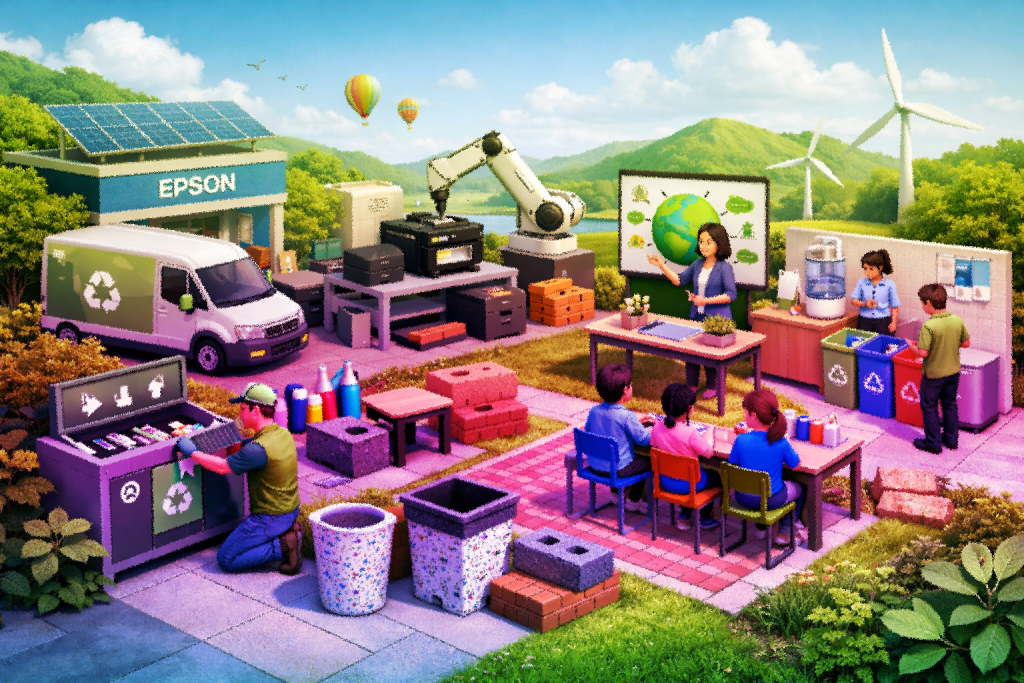
Inside its offices, Epson has removed bottled water and eliminated plastic cutlery and straws. Employees also receive training on proper waste sorting and recycling. These efforts support Epson’s long-term goal to become carbon-negative and underground-resource-free by 2050.
Masako Kusama, president and director of Epson Philippines, said: “For us in Epson Philippines, sustainability is something we practice step by step. We start in our own offices, we include our employees, and we work with our customers.” He added: “When we collect used cartridges or reduce plastic in our daily work, it may look small, but it makes a difference. If we all continue, together it becomes something bigger for the community and for the environment.”
Epson promotes sustainability through education. In 2024, it hosted workshops across Southeast Asia, reaching over 1,100 participants. These sessions taught practical ways to reduce waste at home and work. The impact goes beyond the Philippines. Across the region, Epson helped cut electricity use by 11%, avoided 664 tons of carbon emissions.
“Our ‘Engineered for Good’ approach connects our tradition of innovation with responsibility to the environment,” said Kusama. “We invite our customers, partners, and communities to join us in creating better habits that help both people and the environment,” he added.
Reference: Epson Philippines drives local sustainability initiatives with tangible impact – 2nd Opinion
How it works
ChatGPT, or Chat Generative Pre-Trained Transformer, can expertly generate realistic, human-like text about almost anything. English essays, news articles, computer code, and songs are all examples of what this bot can produce, and all from a simple prompt.
The bot uses a dialogue format in which users can provide both simple and complex instructions, to which ChatGPT will provide a detailed response. It can also answer follow-up questions, admit when it made a mistake, challenge incorrect premises, and reject inappropriate requests—all of which makes it perfect for customer service.
The artificial intelligence research non-profit company behind ChatGPT, OpenAI, was founded in 2015 by Elon Musk, Sam Altman (right), and other Silicon Valley investors. Due to a conflict of interest between OpenAI and the autonomous driving research done with Tesla, Musk stepped down from the board in 2018, but remains an investor, and one who was excited for the launch.

Made available to the public on November 30, 2022, on OpenAI’s website, anyone can sign up for and use ChatGPT for free. The software hit one million users less than a week after its launch. No software has ever been able to so convincingly provide human-like, detailed answers to inquiries as ChatGPT.
A threat to programmers
Because ChatGPT has been able to generate intricate Python code, and programmers have used it to solve coding challenges in obscure programming languages in a matter of seconds, as News18 reports, concerns are arising that such technology can replace human workers.
ChatGPT can create written content very convincingly, concerning everyone from journalists to playwrights. Many fear that the bot will take away jobs from writers and creatives. Fortunately, as per a report by The Guardian, the chatbot currently still lacks the nuance, critical-thinking skills, and ethical decision-making ability required for journalism.
Plus, its current knowledge base stops at 2021, meaning it has a limited knowledge of world events after that. With the power to simply put in a prompt and get ChatGPT to write convincing college-level essays, many schools are concerned about an uptick in plagiarism. Some schools are already blocking the site from their networks and servers.
A tool to detect ChatGPT
Somewhat surprisingly, it was a 22-year-old computer science student at Princeton University, Edward Tian, who developed an app called GPTZero which can detect when an essay was written by AI. It works by looking at two variables, perplexity and “burstiness,” and assigns each of those variables a score.
GPTZero measures firstly how familiar it is with the text presented—according to the sources it was trained upon—and the less familiar it is, the higher the perplexity, meaning it’s more likely human-written. Burstiness is then measured by seeing how variable the text is—checking for varied sentence length.
Reference:
Reference: What exactly is ChatGPT, and what are the concerns?

