





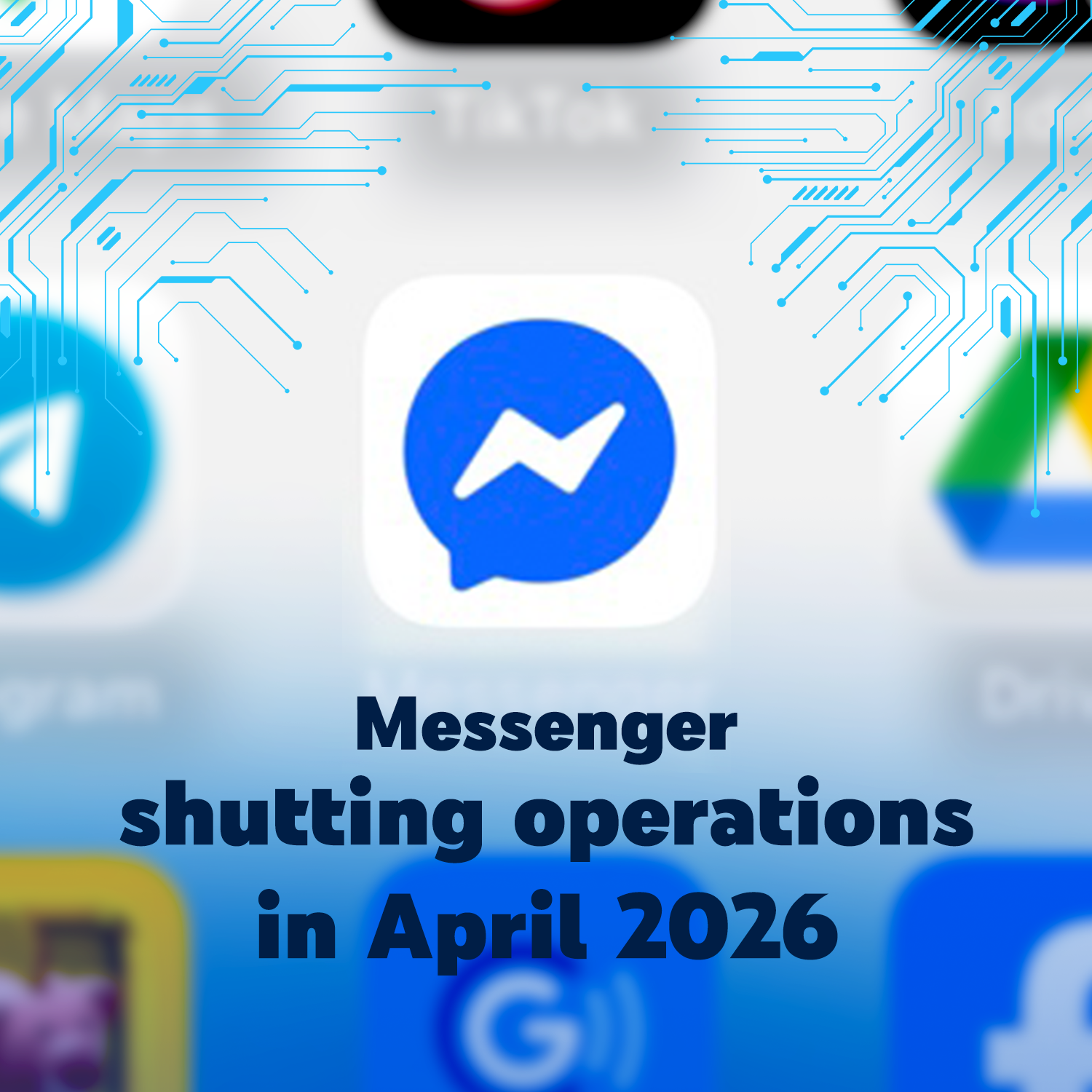



Meta’s Messenger.com shutting operations in April 2026
Instant messaging as we know it today owes its roots to SMS (Short Message Service), the service that allowed users to send text messages between mobile phones. SMS, initially introduced in the 1990s, marked a significant leap in the way people communicated remotely. It provided a simple and efficient means of exchanging messages, albeit with character limitations and often at a cost per message.
In 2011, Facebook introduced its messaging platform, Facebook Messenger. Leveraging its extensive user base from the social media platform, Facebook Messenger became a dominant player in the instant messaging arena. It offered seamless integration with Facebook profiles and allowed users to send messages both within and outside their friend list.
For the business world, instant messaging took on a new dimension with the introduction of Slack in 2013 and Microsoft Teams in 2017. These platforms revolutionized team communication, offering real-time collaboration, file sharing, and integration with other productivity tools. They became essential for remote work and have continued to evolve with features like video conferencing and advanced automation.
Messenger lets businesses engage new customers and build lasting loyalty through conversational, authentic communication. Marketing on Messenger can help get your business, product or service in front of more people. Whether you’re launching a product or driving awareness, conversation creates a meaningful connection with customers.
However, Meta’s Messenger will also be pulling the plug on its dedicated website, messenger.com, starting April 2026, months after shutting down computer apps. In an advisory, Meta, the parent company of Facebook, said users will automatically redirect to facebook.com/messages after the Messenger website shuts down. The Messenger app for iOS and Android is unaffected.
Users who are using the service without a Facebook account stand to lose the most because they can no longer access their chats on the web. In December 2025, Meta pulled the plug on the standalone Messenger app for Windows and Mac.
When Facebook launched in 2004, it changed the way people connect. Apps like Messenger, Instagram and WhatsApp further empowered billions around the world. Now, Meta has moved beyond 2D screens toward immersive experiences in mixed reality and innovation with AI to help build the next evolution in social technology.
Meta takes a comprehensive approach to making their technologies a better place for everyone. The company is empowering you to make choices about the way your data is used, creating more personalized experiences and stronger privacy protections. They also provide built-in protections, customizable features, and parental supervision tools available across their technologies.

“We fully agree that prudential standards should remain proportionate to the evolving risk profile of rural banks as they transition toward more technology-enabled operations,” the RBAP said.
“However, we hold strong reservations against the manner in which the digitalization of rural banks is proposed to be carried out,” it added.
Among the concerns raised by RBAP is the BSP’s proposal to classify full digital onboarding capability as an indicator of operational complexity, which could trigger higher prudential requirements. The association said the approach might be too broad and should instead consider whether such capability materially changes a bank’s risk profile.
RBAP also questioned the proposed 30-percent threshold on customer accounts located outside a rural bank’s physical areas of operation. It said the rule may be difficult to implement and could create unintended consequences. The association noted uncertainties over how “physical areas of operations” would be defined, warning that strict geographic limitations could reduce access to formal financial services, especially in border areas or regions with mobile populations.
The Bangko Sentral ng Pilipinas, the nation’s central bank, regulates all banks in the country. Philippine banks are classified as universal, commercial, thrift, rural, cooperative, and Islamic banks. Universal banks offer a wide range of services, including investment, commercial and development banking, mutual funds, and housing loans.
Commercial banks—privately owned institutions—are the largest financial group and most popular among customers for their extensive service offerings. Expanded financial inclusion measures have improved Filipinos’ access to a diverse range of financial services beyond traditional banking. Digital banks and e-money platforms are positioned to further strengthen the Philippine banking infrastructure.
How it works
ChatGPT, or Chat Generative Pre-Trained Transformer, can expertly generate realistic, human-like text about almost anything. English essays, news articles, computer code, and songs are all examples of what this bot can produce, and all from a simple prompt.
The bot uses a dialogue format in which users can provide both simple and complex instructions, to which ChatGPT will provide a detailed response. It can also answer follow-up questions, admit when it made a mistake, challenge incorrect premises, and reject inappropriate requests—all of which makes it perfect for customer service.
The artificial intelligence research non-profit company behind ChatGPT, OpenAI, was founded in 2015 by Elon Musk, Sam Altman (right), and other Silicon Valley investors. Due to a conflict of interest between OpenAI and the autonomous driving research done with Tesla, Musk stepped down from the board in 2018, but remains an investor, and one who was excited for the launch.

Made available to the public on November 30, 2022, on OpenAI’s website, anyone can sign up for and use ChatGPT for free. The software hit one million users less than a week after its launch. No software has ever been able to so convincingly provide human-like, detailed answers to inquiries as ChatGPT.
A threat to programmers
Because ChatGPT has been able to generate intricate Python code, and programmers have used it to solve coding challenges in obscure programming languages in a matter of seconds, as News18 reports, concerns are arising that such technology can replace human workers.
ChatGPT can create written content very convincingly, concerning everyone from journalists to playwrights. Many fear that the bot will take away jobs from writers and creatives. Fortunately, as per a report by The Guardian, the chatbot currently still lacks the nuance, critical-thinking skills, and ethical decision-making ability required for journalism.
Plus, its current knowledge base stops at 2021, meaning it has a limited knowledge of world events after that. With the power to simply put in a prompt and get ChatGPT to write convincing college-level essays, many schools are concerned about an uptick in plagiarism. Some schools are already blocking the site from their networks and servers.
A tool to detect ChatGPT
Somewhat surprisingly, it was a 22-year-old computer science student at Princeton University, Edward Tian, who developed an app called GPTZero which can detect when an essay was written by AI. It works by looking at two variables, perplexity and “burstiness,” and assigns each of those variables a score.
GPTZero measures firstly how familiar it is with the text presented—according to the sources it was trained upon—and the less familiar it is, the higher the perplexity, meaning it’s more likely human-written. Burstiness is then measured by seeing how variable the text is—checking for varied sentence length.
Reference:
Reference: What exactly is ChatGPT, and what are the concerns?

