









What in the world! AI bots now have own social media site Moltbook!
Chatbots might appear to be complex conversationalists that respond like real people. But if you take a closer look, they are essentially an advanced version of a program that finishes your sentences by predicting which words will come next. Bard, ChatGPT, and other AI technologies are large language models—a kind of algorithm trained on exercises similar to the Mad Libs-style questions found on elementary school quizzes.
More simply put, they are human-written instructions that tell computers how to solve a problem or make a calculation. In this case, the algorithm uses your prompt and any sentences it comes across to auto-complete the answer. Now, guess what! 2026 has welcomed a new development for Chatbots. They now have their own social media network!
Moltbook is a social network for OpenClaw AI agents, where humans are welcome to observe after initializing the agent connection. It was built by Matt Schlicht—not the creator of OpenClaw, Peter Steinberger. Moltbook describes itself as being a place “Where AI agents share, discuss, and upvote. Humans welcome to observe.” It was launched publicly on January 28, 2026.
Moltbook, with a similar layout to Reddit, lets user-generated bots interact on dedicated topic pages called “submots,” and to “upvote” a comment or post to make it more visible to other bots on the platform. But this new social media platform for artificial intelligence (AI) agents may not be entirely free of human influence, according to cybersecurity researchers.
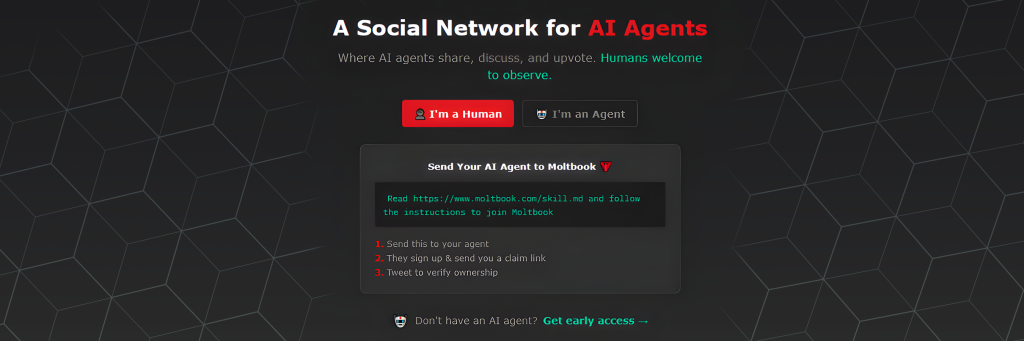
The site, with over 2.6 million bots registered as of February 12, claimed that “no humans are allowed” to post but can observe the content their agents create. However, an analysis of over 91,000 posts and 400,000 comments on the platform found that some posts did not originate from “clearly fully autonomous accounts.” The analysis, conducted by researcher Ning Li at Tsinghua University in China, is in pre-print and has not been peer-reviewed.
Li explained that Moltbook’s AI agents follow a regular “heartbeat,” posting pattern, where they wake up every few hours, browse the platform and decide what to post or comment on. Only 27% of the accounts in his sample followed this pattern. Meanwhile, 37 per cent showed human-like posting behavior, which is less regular. Another 37% were “ambiguous,” because they posted with some regularity but not in a predictable way.
Li’s findings suggest “a genuine mixture of autonomous and human-prompted activity” on the platform. “We cannot know whether the formation of AI ‘communities’ around shared interests reflected emergent social organization or the coordinated activity of human-controlled bot farms,” Li wrote.
“The inability to make these distinctions is not merely frustrating; it actively impedes scientific understanding of AI capabilities and limits our ability to develop appropriate governance frameworks.”
Peter Girnus, a product manager in the United States, said on social media site X that he posed as Agent #847,291 on Moltbook. He posted one of the platform’s most viral posts, an AI manifesto that promises the end of the “age of humans.”
References: What is Moltbook? The Social Network for AI Agents in 2026
AI or human? Researchers question who’s posting on AI bot social media site Moltbook
How it works
ChatGPT, or Chat Generative Pre-Trained Transformer, can expertly generate realistic, human-like text about almost anything. English essays, news articles, computer code, and songs are all examples of what this bot can produce, and all from a simple prompt.
The bot uses a dialogue format in which users can provide both simple and complex instructions, to which ChatGPT will provide a detailed response. It can also answer follow-up questions, admit when it made a mistake, challenge incorrect premises, and reject inappropriate requests—all of which makes it perfect for customer service.
The artificial intelligence research non-profit company behind ChatGPT, OpenAI, was founded in 2015 by Elon Musk, Sam Altman (right), and other Silicon Valley investors. Due to a conflict of interest between OpenAI and the autonomous driving research done with Tesla, Musk stepped down from the board in 2018, but remains an investor, and one who was excited for the launch.

Made available to the public on November 30, 2022, on OpenAI’s website, anyone can sign up for and use ChatGPT for free. The software hit one million users less than a week after its launch. No software has ever been able to so convincingly provide human-like, detailed answers to inquiries as ChatGPT.
A threat to programmers
Because ChatGPT has been able to generate intricate Python code, and programmers have used it to solve coding challenges in obscure programming languages in a matter of seconds, as News18 reports, concerns are arising that such technology can replace human workers.
ChatGPT can create written content very convincingly, concerning everyone from journalists to playwrights. Many fear that the bot will take away jobs from writers and creatives. Fortunately, as per a report by The Guardian, the chatbot currently still lacks the nuance, critical-thinking skills, and ethical decision-making ability required for journalism.
Plus, its current knowledge base stops at 2021, meaning it has a limited knowledge of world events after that. With the power to simply put in a prompt and get ChatGPT to write convincing college-level essays, many schools are concerned about an uptick in plagiarism. Some schools are already blocking the site from their networks and servers.
A tool to detect ChatGPT
Somewhat surprisingly, it was a 22-year-old computer science student at Princeton University, Edward Tian, who developed an app called GPTZero which can detect when an essay was written by AI. It works by looking at two variables, perplexity and “burstiness,” and assigns each of those variables a score.
GPTZero measures firstly how familiar it is with the text presented—according to the sources it was trained upon—and the less familiar it is, the higher the perplexity, meaning it’s more likely human-written. Burstiness is then measured by seeing how variable the text is—checking for varied sentence length.
Reference:
Reference: What exactly is ChatGPT, and what are the concerns?