









DICT eyes new policy for social media user verification in the country
The government is making fairly commendable strides when it comes to adopting modern technology in providing services to the citizens. The series of seminars conducted by Advance Solutions Inc (ASI) on different occasions was aimed at updating government agencies on the current technology trends.
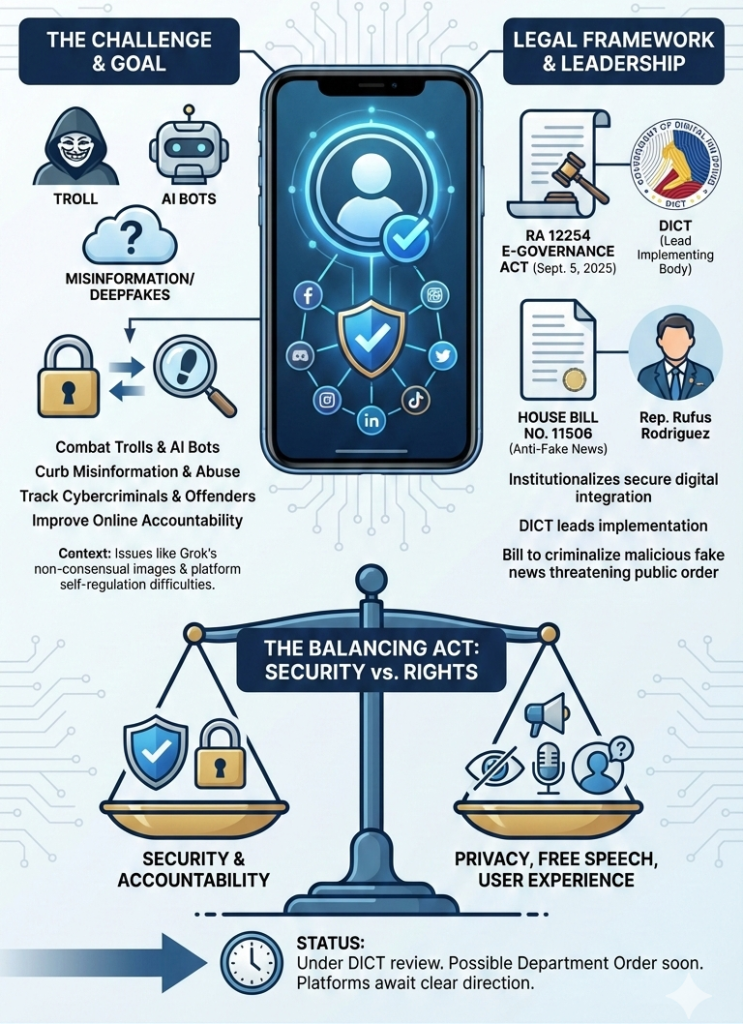
On Sept. 5, 2025, President Ferdinand Marcos Jr. signed into law a measure institutionalizing the government’s digital integration for a more regulated and secure information and communications system. The law is known as Republic Act 12254, or the E-Governance Act.
The new law likewise covers all back-end government operations between and across agencies and government-to-government transactions. It also identifies the Department of Information and Communications Technology (DICT) as the lead implementing body and administrator of the law.

One intelligence everywhere
Lenovo designed Qira as a single intelligence that follows users across PCs, tablets, smartphones, and wearables. It maintains continuity as people shift screens, environments, and tasks. The system operates through three core attributes: presence, actions, and perception.
Presence focuses on accessibility and consistency. Qira integrates directly into the operating system and offers multiple entry points. Users can invoke it by saying “Hey, Qira,” pressing a dedicated key, or tapping a persistent interface element. It can also remain silent until needed.
Actions define how Qira gets work done. The system can act on a user’s behalf using device capabilities and local AI, including offline processing. It coordinates actions across apps and devices without forcing users to manage each step manually.
Perception underpins personalization. Qira builds a fused knowledge base using user-selected interactions, memories, and documents. Cross-device sensing allows it to understand context and continuity over time, while privacy and consent remain central.
Reference: Lenovo debuts world’s first ambient, cross-device AI system at CES 2026
Meanwhile, the DICT is looking at a new policy that would require all social media users in the Philippines to be verified. The move is meant to improve accountability online and make it easier to track offenders and cybercriminals.
According to DICT, the proposal is now under review by its policy and legal team. A department order could be released as early as next week. The announcement was made during the Globe–Starlink partnership event in Taguig City.
The agency explained that verification could help reduce trolls and automated accounts, often called AI bots, which spread misinformation and abuse. It also comes after issues with Grok, an AI chatbot from xAI, that generated explicit, non-consensual images.
DICT added that social media platforms find it difficult to self-regulate since they profit from traffic. Platforms have expressed support for the idea but are waiting for clear government direction. If implemented, the measure could change how Filipinos use social media. While it can curb trolls, it also raises questions about privacy, free speech, and user experience.
In a related ASI story, Cagayan de Oro City 2nd District Representative Rufus Rodriguez filed a bill in June 2025 criminalizing the spread of false information, especially those that threaten public order or national security. Rodriguez recognized that in filing the House Bill No. 11506, the right to freedom of speech, press, and expression is protected as it was enshrined under the Section 4, Article III of the 1987 Constitution.
However, Rodriguez noted that the rights are not absolute under a Supreme Court ruling, emphasizing that “[c]ertain categories of speech – such as obscenity, defamation, incitement to violence, false advertising, and speech that poses a clear and present danger to public order or national security – are not entitled to constitutional protection.”
The lawmaker underscored that as the bill criminalizes false information that puts public order and national security at risk, it is crafted to “withstand constitutional scrutiny by defining fake news [precisely] requiring proof of both malicious intent and actual or probable public harm.”
Reference: DICT mulls social media user verification in the Philippines – Technobaboy