






Get to Know the Thinkers Who Built the Digital Age
The things and stuff that we get to enjoy today don’t just appear like magic or out of wishes from the “genie” in a bottle. It has always been that something has to start somewhere and from someone. Through the scientific method, we as a species have been able to create technology, culture, architecture, and so much more to help us solve the complexities of life on this planet.
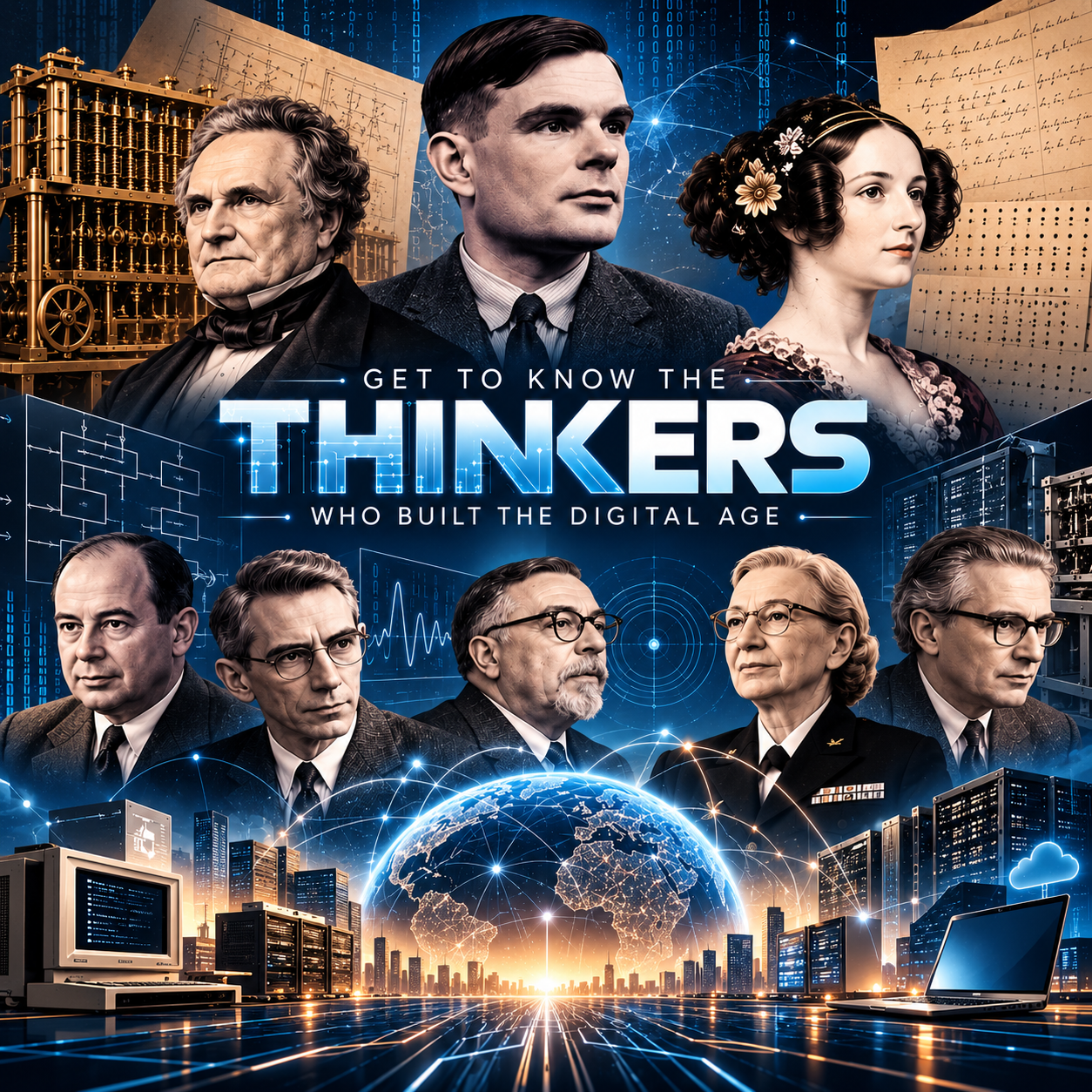
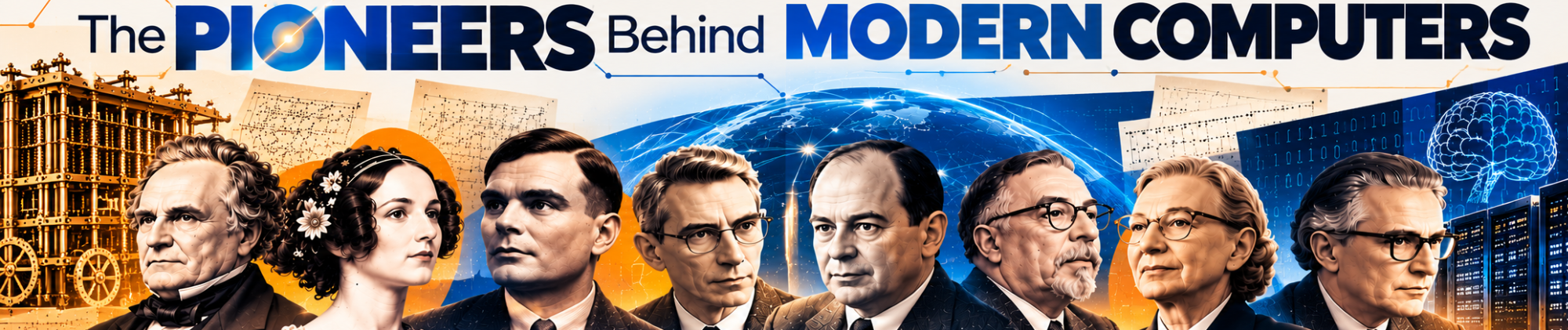
Long before computers became everyday tools, a small group of thinkers laid the intellectual foundation that made modern computing possible. Some worked with pure theory, others built early machines, and many did both. Their ideas advanced technology and defined what computers could be. Here’s the first batch of famous computer scientists who shaped the world of computing:
Alan Turing
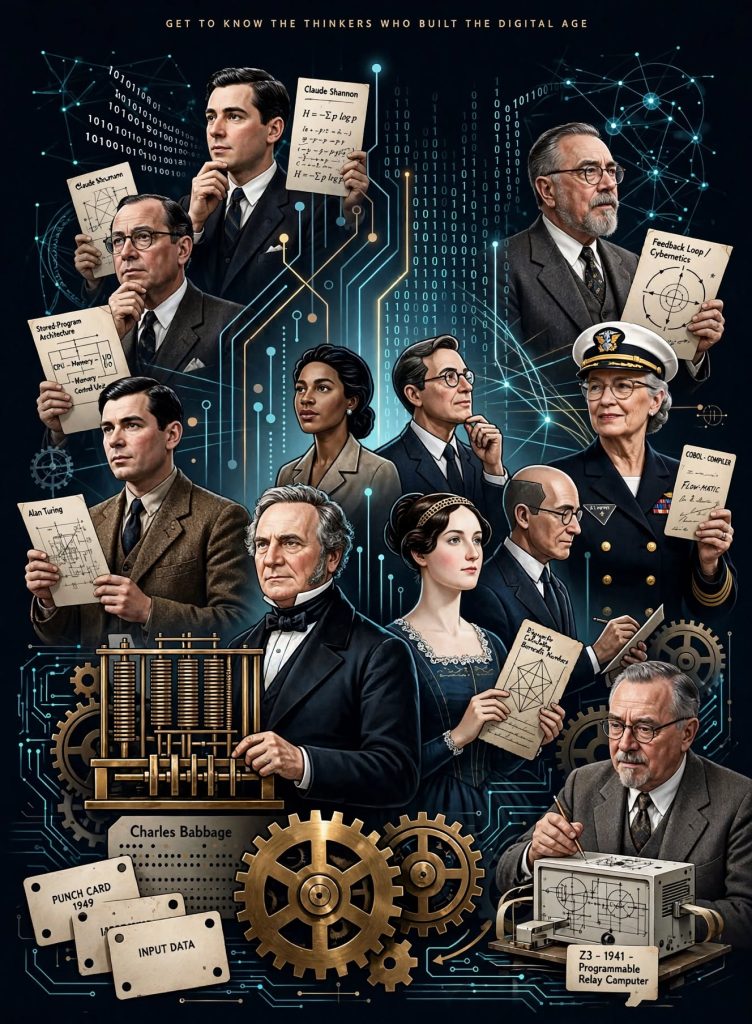
Alan Turing helped define the concept of computation itself through the theoretical “Turing machine,” which remains central to computer science today. During World War II, his work at Bletchley Park also played a critical role in breaking German encryption, demonstrating the real-world power of computation. His ideas still shape discussions around artificial intelligence and machine intelligence.
Charles Babbage
Charles Babbage designed the Analytical Engine, a mechanical device that introduced ideas like programmable instructions, memory, and conditional logic. Although the machine was never completed, its architecture closely resembles modern computers. His work laid the mechanical and conceptual groundwork for future computing.
Ada Lovelace
Ada Lovelace recognized that Charles Babbage’s Analytical Engine could do more than calculate numbers, envisioning it as a machine capable of manipulating symbols and concepts. Her notes included what is widely regarded as the first published algorithm intended for a machine. This insight earned her recognition as the world’s first computer programmer.
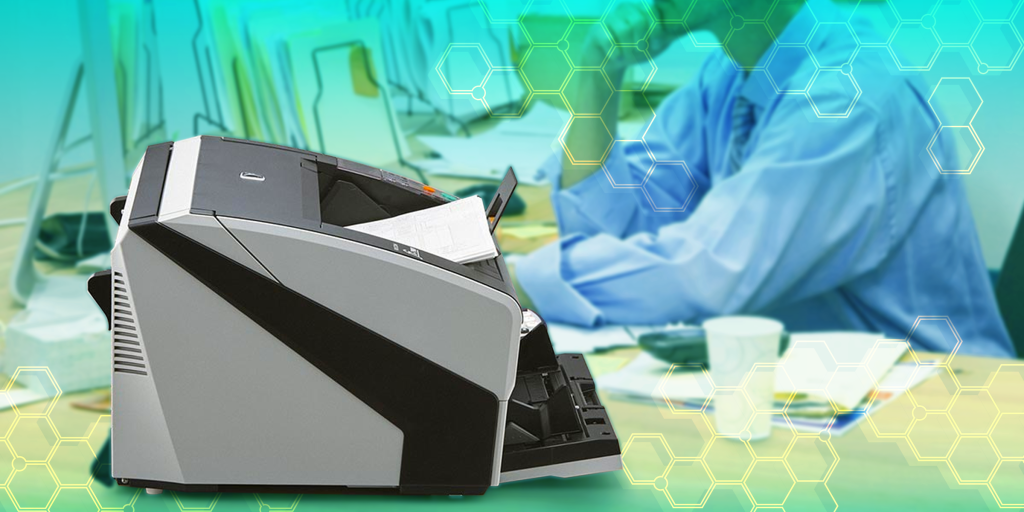
High-Resolution Scanning: Ricoh scanners capture images in high resolution, producing clear and detailed digital copies suitable for various document types.
Speed and Efficiency: These scanners offer fast scanning speeds to efficiently handle large document volumes, ultimately enhancing workplace productivity.
Optical Character Recognition (OCR): Integrated OCR technology allows for the conversion of scanned documents into editable and searchable text, simplifying document management and retrieval.
Multi-Feed Detection: Built-in sensors prevent misfeeds by detecting when multiple pages are pulled into the scanner at once, ensuring every page is accurately scanned.
Network Connectivity: Ricoh scanners offer options for network connectivity, enabling multiple users to access the scanner from different devices and facilitating convenient sharing and storage of scanned documents.
Automatic Document Feeder (ADF): The ADF feature allows for the scanning of multi-page documents without the need for manual page feeding, saving time and effort.
Double-Sided Scanning: Ricoh scanners are capable of simultaneous two-sided scanning, known as duplex scanning, essential for efficient document processing.
Image Enhancement Tools: Software features clean up and enhance the quality of scanned images, improving legibility by removing imperfections and adjusting alignment.
Security Features: Ricoh scanners are equipped with advanced security measures to protect sensitive information, including options for password protection, data encryption, and secure file transmission.
Compatibility and Integration: These scanners are compatible with various operating systems and seamlessly integrate with document management systems and cloud storage solutions.
Compact Design and Energy Efficiency: Designed to fit modern workspaces, Ricoh scanners operate with energy efficiency to reduce power consumption, supporting sustainable office environments.
Reference: Navigating the Scanning Pathway to Digital Transformation
John von Neumann
John von Neumann proposed the stored-program architecture that allows data and instructions to reside in the same memory. This design dramatically improved flexibility and efficiency in early computers. Nearly all modern computers still follow this fundamental structure.
Claude Shannon
Claude Shannon founded information theory, introducing a mathematical way to measure information and communication. His work made reliable digital communication possible despite noise and errors. Modern data compression and transmission rely heavily on his theories.
Norbert Wiener
Norbert Wiener developed cybernetics, the study of control and communication in machines and living systems. His work influenced early computing, automation, and systems theory. Wiener also raised early ethical concerns about the societal impact of intelligent machines.
Grace Hopper
Grace Hopper helped create the first compilers, allowing programmers to write code in human-readable language. She was instrumental in developing COBOL, which became widely used in business and government. Her work made programming accessible to a far broader audience.
Konrad Zuse
Konrad Zuse built the Z3, one of the first programmable digital computers. Working largely in isolation during World War II, he independently developed key computing concepts. His machines demonstrated that practical, programmable computers were achievable.
Reference: 20 famous computer scientists who shaped the world of computing