









AI’s Role in the Workplace: HP Work Index Report
AI is transforming how people live and work. Market leaders leverage this new wave of AI innovation to gain a competitive advantage. Over the past few years, not only has how we work on a global scale changed, but also how we think about what work is, and what the future of it should look like.
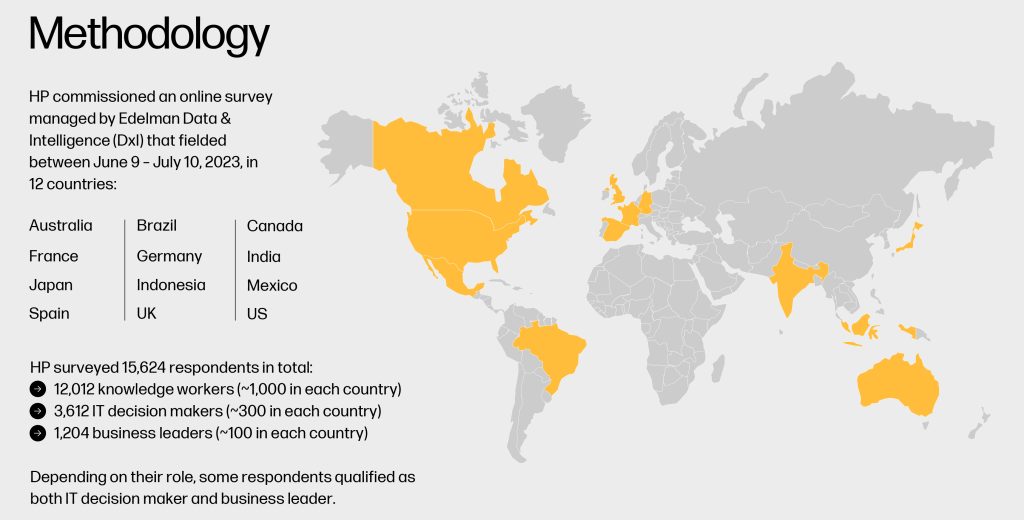
HP’s Work Relationship Index (WRI) launched in September 2023, is a global study that offers a new way for society to monitor, measure and gain insights into how employees in various industries around the world feel, what they want, why they crave more satisfying work experiences and how organizations and their leaders must adapt to meet growing expectations.
AI is seen as a key to unlocking a better relationship with work – with business leaders and IT decision makers particularly enthusiastic. To increase knowledge worker buy-in around AI – and to leverage the technology to improve work relationships – organizations need to double-down on how AI can support Fulfillment, one driver of a healthy relationship with work identified by the Work Relationship Index.
AI can be a key contributor to a core driver of a healthier relationship with work: Fulfillment. Employees have signaled that they are looking for greater meaning in their work – but only a few are consistently experiencing this today.
All employee groups believe AI can play an important role in improving not only their work-life balance but also their relationship with work. To a similar extent, employees recognize the potential AI brings to offload tedious tasks and make the workday easier and more productive. Only 28% of knowledge workers say that their work consistently gives them purpose; that they feel connected to the work they do; and that the work they do is meaningful to them.
Business leaders’ critical role is clear: to educate their employees on the possibilities of AI – and take the lead on effectively introducing it. 72% of business leaders are more likely to see AI’s benefits than knowledge workers. Workers in growing economies see AI as a greater source of opportunity and progress than their peers in mature economies.
This creates an opportunity for organizations to lean into the benefits that AI can bring to this aspect of inspiring healthier relationships with work. Employees already recognize that AI has the potential to make work more meaningful and enjoyable.
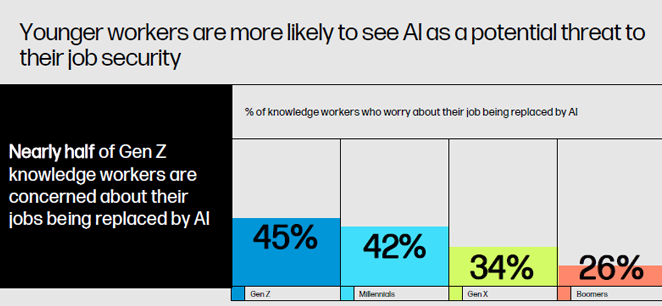
While there is appetite for the use of AI, employees harbor concerns about its potential impact on their job security. Younger workers are more likely to see AI as a potential threat to their job security. Nearly half of Gen Z knowledge workers are concerned about their jobs being replaced by AI.
The WRI has identified 6 distinct drivers that fuel a healthy relationship:
Fulfillment: Purpose, meaning and empowerment at work; Leadership: Empathy and emotional connection from those in charge; People-centricity: Decision-making with people at the heart; Skills: Confidence-building by tapping into the enthusiasm employees have for learning new skills; Tools: The right technology to drive employee engagement; Workspace: Flexibility and trust in where employees work, enabled by seamless transitions.