



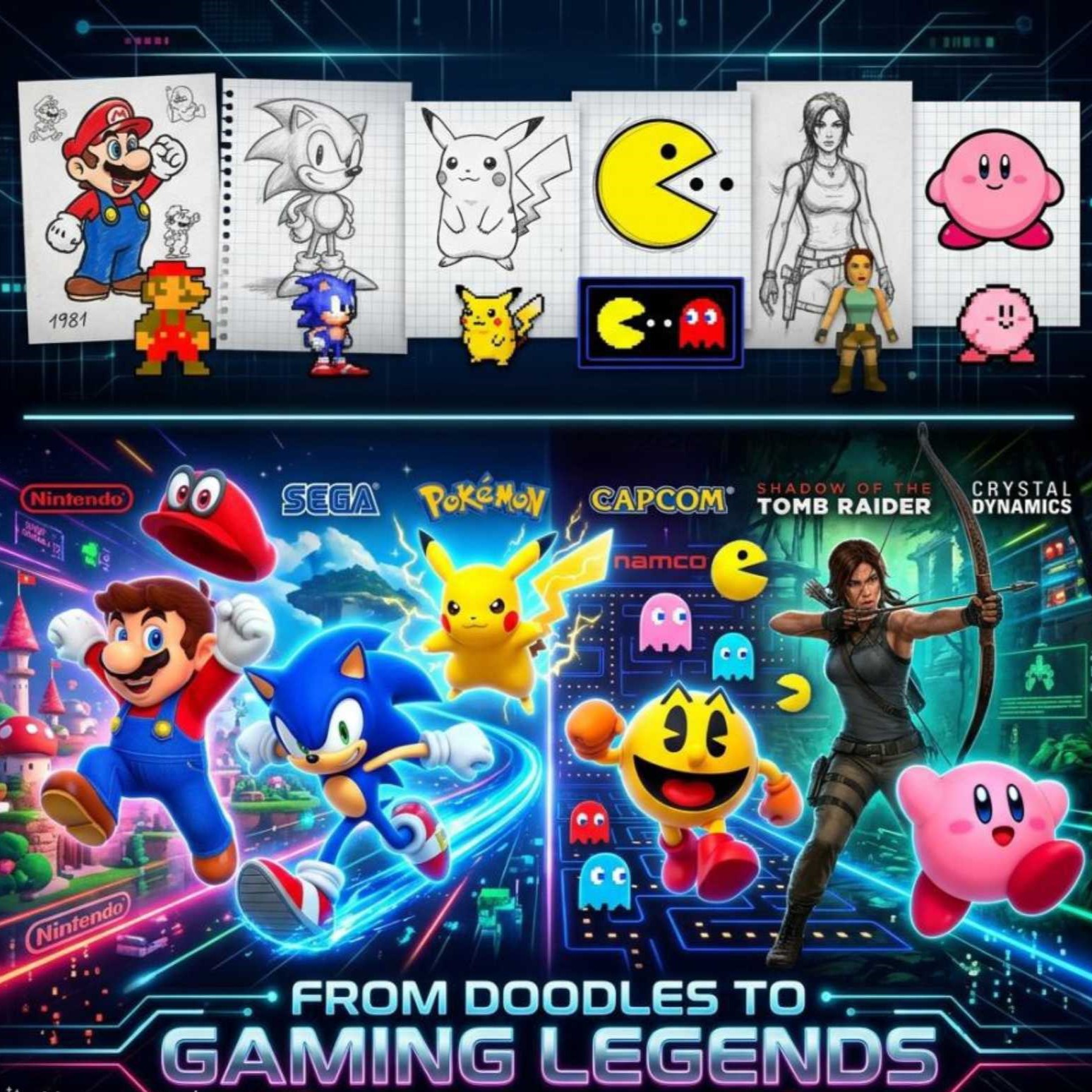


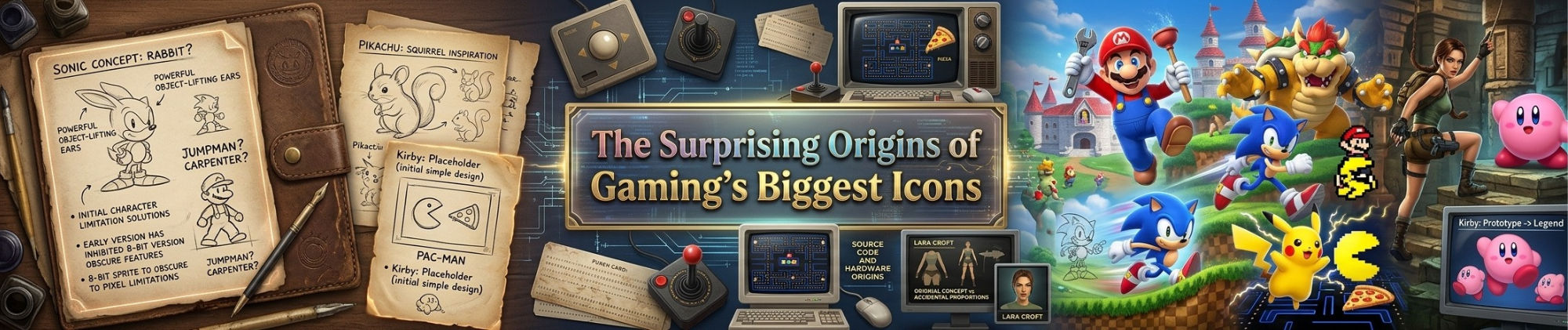
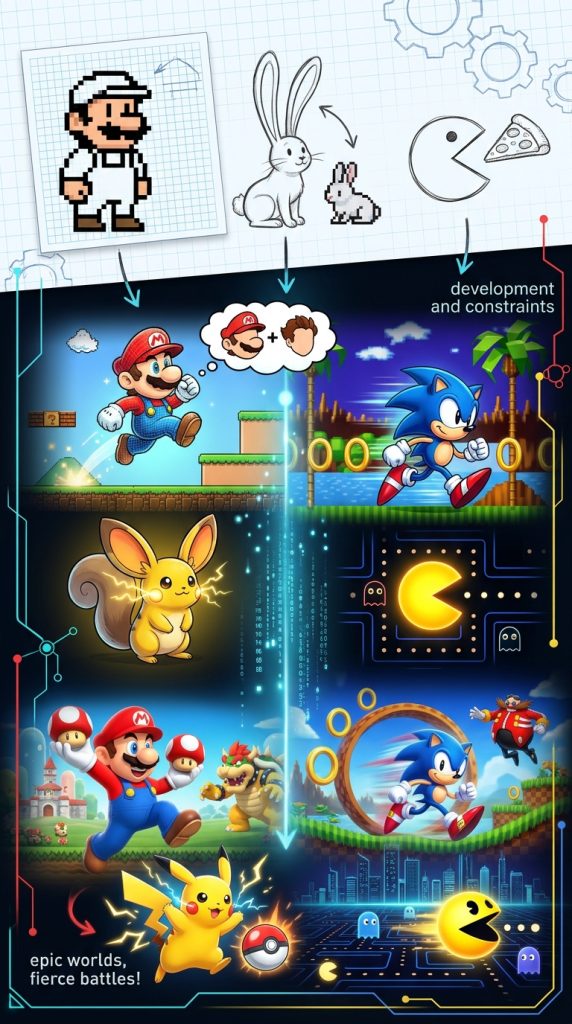
Origins of video game characters: from doodles to epic worlds, fierce battles!
Did you know that many of your favorite characters started as mere doodles or technical accidents? Well, from characters born out of licensing failures to those inspired by actual pets, the stories behind their debuts are frequently as entertaining as the games themselves.
However, the creation of a gaming icon often involves a mix of hardware limitations, late-night inspiration, and sometimes just a bit of sheer luck. So, you might want to keep this thought in mind while you spend hours guiding your favorite characters through epic worlds and intense battles! Now, get to discover how they came to be. Let’s begin with the first batch:
Mario’s career change
Before Mario became the most recognizable plumber in the world, he was not a plumber at all. He was a carpenter in the original Donkey Kong and was even nicknamed “Jumpman” early on. Nintendo gave him a mustache and a hat to hide the fact that they could not render facial expressions and hair with the limited pixels in the early ’80s.
Sonic’s need for speed
Sega’s hedgehog was not always supposed to be a hedgehog. An early concept for Sonic featured him as a rabbit with powerful ears that could pick up objects. There was also an armadillo version at one point.
High-Resolution Scanning: Ricoh scanners capture images in high resolution, producing clear and detailed digital copies suitable for various document types.
Speed and Efficiency: These scanners offer fast scanning speeds to efficiently handle large document volumes, ultimately enhancing workplace productivity.
Optical Character Recognition (OCR): Integrated OCR technology allows for the conversion of scanned documents into editable and searchable text, simplifying document management and retrieval.
Multi-Feed Detection: Built-in sensors prevent misfeeds by detecting when multiple pages are pulled into the scanner at once, ensuring every page is accurately scanned.
Network Connectivity: Ricoh scanners offer options for network connectivity, enabling multiple users to access the scanner from different devices and facilitating convenient sharing and storage of scanned documents.
Automatic Document Feeder (ADF): The ADF feature allows for the scanning of multi-page documents without the need for manual page feeding, saving time and effort.
Double-Sided Scanning: Ricoh scanners are capable of simultaneous two-sided scanning, known as duplex scanning, essential for efficient document processing.
Image Enhancement Tools: Software features clean up and enhance the quality of scanned images, improving legibility by removing imperfections and adjusting alignment.
Security Features: Ricoh scanners are equipped with advanced security measures to protect sensitive information, including options for password protection, data encryption, and secure file transmission.
Compatibility and Integration: These scanners are compatible with various operating systems and seamlessly integrate with document management systems and cloud storage solutions.
Compact Design and Energy Efficiency: Designed to fit modern workspaces, Ricoh scanners operate with energy efficiency to reduce power consumption, supporting sustainable office environments.
Reference: Navigating the Scanning Pathway to Digital Transformation
Pikachu’s sweet inspiration
While many believed Pikachu was based on a mouse, Pokémon designer Atsuko Nishida has confirmed that it was actually a squirrel. Pikachu’s design was inspired by the ability to store electricity in its cheeks, just like a squirrel stores nuts in theirs. Pikachu’s designer also added large ears to differentiate it from other Pokémon.
Pac-Man’s lunch break
Game designer Toru Iwatani found inspiration for Pac-Man’s character design after staring at a pizza with a slice missing. While developing the character, he felt he should make a game that focused on “eating” instead of the typical shooting games at the time in order to attract more female players.
Lara Croft’s accidental curves
Lara Croft was accidentally given larger proportions by developer Toby Gard, who was adjusting her proportions in the initial Tomb Raider build. When the team noticed, they encouraged him to keep the figure, as they believed it would help sales. Lara Croft was even intended to be male at one point.
Kirby’s placeholder look
Kirby was supposed to be a simple yellow ball character but ended up sticking due to Kirby’s saucer-like appearance when his face was created. Designer Masahiro Sakurai simply used Kirby as a placeholder sprite and worked on the character’s mechanics throughout Dream Land’s development.
Reference: 20 origins of popular video game characters