










Dell cites critical RAM shortage in move to set massive price hikes up to 30%
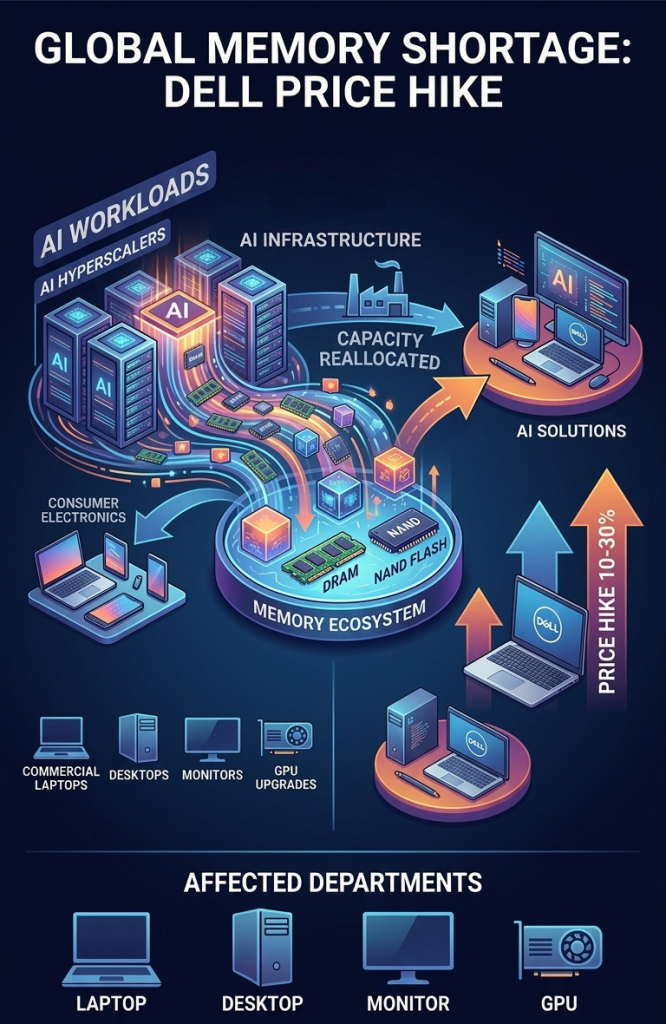
The rapid expansion of AI infrastructure and workloads is exerting significant pressure on the memory ecosystem. These AI workloads require large amounts of memory, and the shortage, in part, is driven by a reallocation of manufacturing capacity away from consumer electronics toward high-margin memory solutions to support AI.
Dell Technologies has prepped significant price hikes up to 30% for corporate products in Dec. 2025 and issued a warning that ordering today for future delivery does not lock in current pricing. The company implemented massive price increases across all of its commercial laptop offerings on Dec. 17, 2025 according to an internal report obtained by Business Insider.
The price increases primarily target laptop and desktop models with higher amounts of RAM or SSD storage capacity, attributed to the critical RAM shortage being felt around the world due to AI hyperscalers. However, some professional monitors and GPU upgrades will also see higher price tags starting on Dec 17. The affected Dell commercial portfolio will, on average, be 10-30% higher.

“We fully agree that prudential standards should remain proportionate to the evolving risk profile of rural banks as they transition toward more technology-enabled operations,” the RBAP said.
“However, we hold strong reservations against the manner in which the digitalization of rural banks is proposed to be carried out,” it added.
Among the concerns raised by RBAP is the BSP’s proposal to classify full digital onboarding capability as an indicator of operational complexity, which could trigger higher prudential requirements. The association said the approach might be too broad and should instead consider whether such capability materially changes a bank’s risk profile.
RBAP also questioned the proposed 30-percent threshold on customer accounts located outside a rural bank’s physical areas of operation. It said the rule may be difficult to implement and could create unintended consequences. The association noted uncertainties over how “physical areas of operations” would be defined, warning that strict geographic limitations could reduce access to formal financial services, especially in border areas or regions with mobile populations.
The Bangko Sentral ng Pilipinas, the nation’s central bank, regulates all banks in the country. Philippine banks are classified as universal, commercial, thrift, rural, cooperative, and Islamic banks. Universal banks offer a wide range of services, including investment, commercial and development banking, mutual funds, and housing loans.
Commercial banks—privately owned institutions—are the largest financial group and most popular among customers for their extensive service offerings. Expanded financial inclusion measures have improved Filipinos’ access to a diverse range of financial services beyond traditional banking. Digital banks and e-money platforms are positioned to further strengthen the Philippine banking infrastructure.
Dell Technologies Chief Operating Officer Jeff Clarke said the company is focused on mitigating the looming memory shortage, which he sees impacting its product pricing across the board. This includes reworking product configurations, product availability, and “adjust mix” in the coming quarters.
“We’re going to do everything we can to minimize the impact, but the fact is, the cost basis is going up across all products,” Clarke said. “No one more unique than others. Everything uses a CPU, has DRAM, and has storage in it.” He added: “We’re in a very unique time. It’s unprecedented. We have not seen costs move at the rate that we’ve seen. And by the way, it’s not unique to DRAM, it’s NAND.”
Clarke said as AI token growth accelerates, customers around the world are demanding more computational memory, while server consolidation is driving denser configurations with more DRAM, and the company is in the midst of a PC refresh that also relies on the availability of memory from suppliers.
Beginning in December 2025, Dell Pro and Pro Max laptops and desktops with 32GB of RAM will become $130 to $230 more expensive. Computers with 128GB, Dell’s highest offering, will see prices rise anywhere from $520 to $765 per device. Notebooks ordered with 1TB of internal SSD storage will become $55 to $135 more expensive.
Other price increases include monitors, a curious increase as monitors and displays do not contain RAM or NAND flash memory. Regardless, the Dell Pro 55 Plus 4K monitor is set to rise from $1,349 to $1,499 once the other price increases take effect. GPU prices in the commercial realm will also rise with the tide. Dell laptops with the Nvidia RTX Pro 500 Blackwell GPU 6GB will increase by $66, while stepping up to a 24GB Blackwell GPU will cost $530 more.